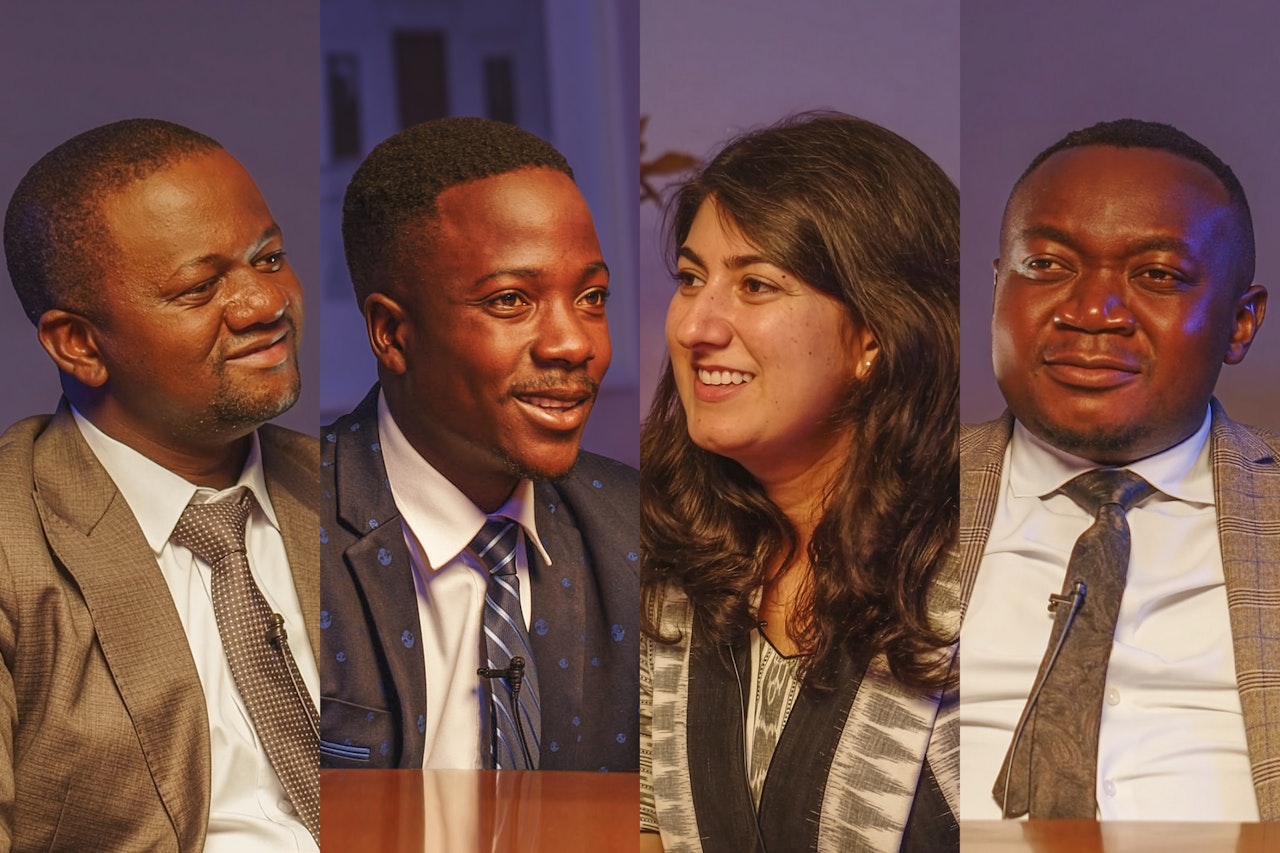
BAHÁ’Í WORLD CENTRE — In the latest Bahá’í World News Service podcast episode, participants from India, Kenya, and Zambia discuss how Bahá’í educational programs are enabling young people to develop the qualities, attitudes, and practical abilities needed to serve the well-being of those around them.
Victor Jidayi Mabale, an Auxiliary Board member from Kenya, described how, in his village, the progress of young people has increasingly become a concern of the whole community.
“Village elders are beginning to see they have a role to play,” Mr. Mabale said, as do families. Religion, too, has its part in “releasing the potential of these young people,” he explained, above all through a growing consciousness that “a human being has been created noble.”
Martha Moghbelpour, a member of India’s Bahá’í National Spiritual Assembly, said that efforts often begin modestly. “It really starts with a few people, a few individuals,” she said, “and at the heart of it, we find it's true friendships.”
She recounted how a group of some ten young people in a village in her region, already facilitating children’s classes and youth groups, responded when schools closed during the pandemic by forming tutorial groups so that children would not fall behind. Their efforts brought to light how few children had books of their own, and once restrictions eased they invited families across the village to contribute books toward a library. Parents and community leaders then gathered to consult about the library’s purpose and how it might be used, and everyone had a part in establishing it.
The library soon grew into a place where tutorial classes were held in the evenings, and groups of mothers now gather there for spoken English classes. One of the young people decided to become a teacher and opened a pre-primary school on the rooftop of his home. Another studied computer science and, after completing a master's degree, returned to the village to establish a computer center.
“It’s very exciting when the right conditions are created and the community and the institutions are there to support,” said Ms. Moghbelpour. “But really youth themselves take charge... and they help one another to go forward.”
Fungai Bangajena, a member of the Auxiliary Board in Zambia, described how some young people in his village can become disheartened early in their studies, when financial pressures at home narrow what seems possible to them—an experience familiar to young people in many parts of the world. For a long time, he said, they found little encouragement outside their own homes. As conversations about the progress of the young have gradually taken root in the village, young people are beginning to hear something different: “There is support other than just your home. There is actually support outside your home. The whole community is thinking about you.”
Vahid Kaumba, a participant in community-building initiatives in Zambia, described how youth in his community are beginning to ask what their education is ultimately for, and whom it will serve. Some have gone on to change their field of study, weighing it against the needs of their villages—one turning to food science and nutrition with the health of his community in mind—and in doing so have drawn other young people into the same reflection.
Across the three countries, Mr. Mabale noted, a common thread runs through these experiences. “In different places... the story seems to be the same,” he said, “of a youth who is advancing along that path, learning to think coherently about different aspects of life, and the community learning also to coherently provide the conditions for this young person to release this potential.”
The podcast episode is part of the “In Conversation” series, a collective exploration by several individuals of the practical application of Bahá’í principles to the building of peaceful societies.