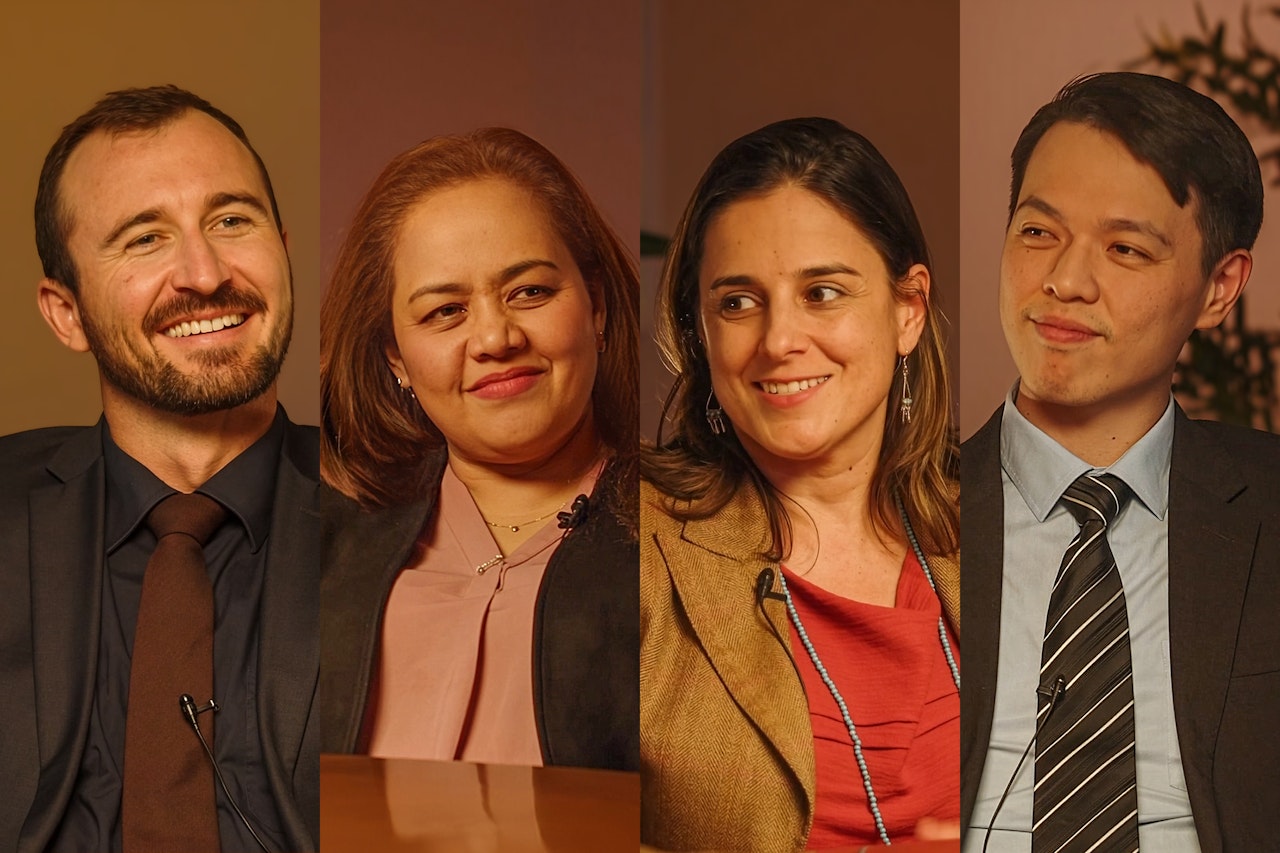
BAHÁ’Í WORLD CENTRE — In a new episode of “In Conversation,” four members of the Continental Boards of Counsellors describe how communities in several countries are learning to accompany young people on a path that brings coherence to every dimension of their lives: from early adolescence through university and into marriage and family life.
“What we’re trying to discover is how do we really help promote the coherence in a young person’s life?” reflects Jeffrey Sabour, a member of the Board of Counsellors in Australasia. “How can their spiritual identity and their spiritual hopes and aspirations give meaning to the material dimensions of their life?”
This question of coherence—how the spiritual and material aspects of a young person’s development can reinforce rather than compete with one another—runs through the wide-ranging conversation, which draws on experience from Malaysia, New Zealand, the Philippines, and the United States.
Discovering spiritual identity, fostering purpose
Several of the guests describe how Bahá’í moral and spiritual educational programs for youth are helping participants develop a sense of identity grounded in spiritual reality rather than shaped by the pressures of consumer culture and social media.
Mr. Sabour observes that young people are “aggressively targeted” by forces that reduce their sense of identity to appearances, popularity, and material achievement. When they cannot meet these standards, he says, “at the age of 12 or 13, they think, who am I? I’m nothing.”
In contrast, the junior youth spiritual empowerment program offers a different understanding: “A human being is a soul, is a mind, is capable of beauty in terms of the acquisition of these qualities of truthfulness, of love, of compassion, of generosity.”
This process of identity formation does not happen in isolation. Melonna Njang, a member of the Board of Counsellors in Asia, emphasizes that young people explore their spiritual identity “in a collective setting,” where the group itself becomes a context for growth.
“Change is not really brought about by individual efforts,” Mrs. Njang explains, “but in a collective setting, having that group where you are exploring your true identity together, and then expressing it in the field of service.”
The intergenerational dimension of this process is also significant. As Mrs. Njang describes it, young people who discover their own capacities naturally begin to serve younger generations, and “even the relationships are redefined” as bonds between age groups strengthen within a community.
Service as the thread that connects
A recurring theme in the conversation is the idea that service is not one activity among many, but the thread that gives meaning to education, work, and relationships.
Mr. Sabour shares an experience from his neighborhood in New Zealand. A group of about five young men, aged 15 and 16, who had participated in the junior youth program noticed that younger peers in their community were struggling with reading comprehension.
In consultation, they decided to set up a weekly tutorial group. “What started to happen was that the 15- and 16-year-old youth became so much more responsible,” Mr. Sabour recalls. “You could see that they were progressing as well in their own comprehension and their own intellectual development.”
Nicholas Loh, a member of the Board of Counsellors in Asia, observes that in many countries with which he is familiar, young people increasingly hear from their peers and others that the world is too difficult to change and that they should simply look out for themselves.
Engaging youth in a conversation about service, he says, has become “a conversation of hope.” Mr. Loh notes that communities are learning that thinking about one’s community “could constitute part of one’s education,” as the qualities and attitudes developed through service strengthen a young person’s own growth.
Over time, this orientation toward service extends into later stages of life. Mr. Loh describes how in some communities where youth have been deeply engaged in service, the approach to marriage is also starting to change. Young couples are beginning to think about marriage and family not as a retreat into private life but as a deepening of their capacity to serve their communities.
Intellectual life and the university years
The conversation turns to how these patterns of service and reflection are finding expression in university settings. Natasha Bruss, a member of the Board of Counsellors in the Americas, describes the role of the Institute for Studies in Global Prosperity (ISGP), one of whose purposes is to explore, with others, the complementary roles that science and religion can play in the advancement of civilization.
The Institute’s seminars, Ms. Bruss explains, are helping university students think about how their academic studies can be pursued with service at the center.
“This path that youth now have for four years of their undergraduate studies is really profound,” Ms. Bruss says, “because they can bring those difficult questions to a cohort of their friends over the course of their studies.”
Mr. Loh describes how one university student, after participating in such gatherings, began organizing regular informal sessions where peers could explore the relationship between science and religion. These social spaces, he says, are growing in some universities, as more students discover that exploring the harmony of science and religion as two systems of knowledge opens up new ways of thinking.
Ms. Bruss adds that on some campuses, young people are coming together for devotional gatherings followed by deeper discussions on topics they face. In the United States, during a series of youth conferences on reflecting about community-building activities, young people have been studying a message from the Universal House of Justice to the American Bahá’í community that addresses racial injustice.
This message, says Ms. Bruss, is helping young people see their service in the context of building a society with “oneness at the center.”
Responding to anxiety and isolation
The guests also reflect on the growing challenges of anxiety, depression, and isolation among young people—challenges that Mrs. Njang describes as “very new” for communal societies in Southeast Asia, where forces of individualism and materialism have in recent times increasingly taken hold.
In this context, the simple act of coming together in a study circle to explore spiritual concepts is helping young people, Mrs. Njang says, “to combat these feelings of loneliness by having a shared sense of purpose.” She emphasizes that this process reconnects youth with “their nobility” and offers a collective context for exploring identity and serving others.
Mr. Loh observes that when groups of youth come together in an environment oriented toward service and study, something shifts: “If someone chooses to put his phone down on his own, that means he must have found something which is more meaningful.” Rather than being enslaved by technology, he says, young people in these settings are beginning to chart “a new path” in which technology serves their work in communities.
Ms. Bruss reflects that there is something inherently healing in turning outward: “When you turn to others to help others, your hardship starts to go away. Service is the greatest healing medicine for humanity.”
The podcast episode is part of the “In Conversation” series, a collective exploration by several individuals of the practical application of Bahá’í principles to the building of peaceful societies.