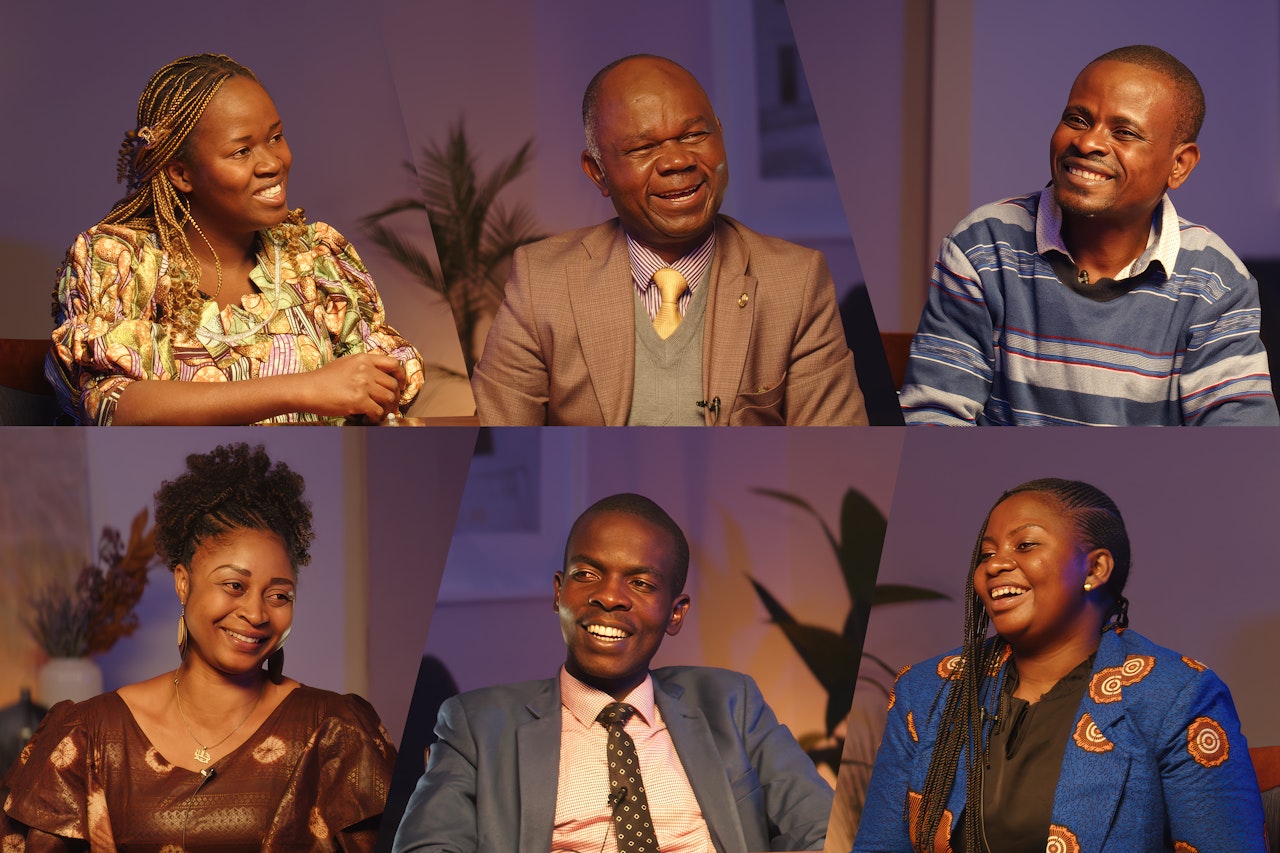
The latest podcast episode explores efforts in a DRC village to learn about addressing long-standing challenges in education, agriculture, and societal harmony.
April 5, 2026
BAHÁ’Í WORLD CENTRE — As part of consultations at the Bahá’í World Centre on the development of Bahá’í communities, several participants from the Democratic Republic of the Congo sat down with the News Service for a podcast episode to reflect on the Bahá’í educational initiatives in their country.
Exploring broader developments in recent years, they discuss Canjavu, a village in South Kivu, as an example of how residents have been learning to address long-standing challenges in education, agriculture, and societal harmony.
“We have a moral and spiritual education system that has helped us develop capacities in our efforts to contribute to social transformation,” says Amélia Mujinga, a member of the Board of Counsellors in Africa.
Education has played a central role in Canjavu’s renewal over the decades. Years ago, a school was established in the village, but without adequate support, teachers eventually had to leave to find work elsewhere, and the school ceased operating. Children had to travel long distances to attend school, which was particularly challenging during the rainy season.
“One of the most striking developments in recent times was how the entire village came together to revive a school that was no longer there,” says Chanceline Zawadi, a member of a Bahá’í agency at the national level.
The process of re-establishing the school began with residents, including village chiefs and people trained as teachers by a Bahá’í-inspired educational organization, consulting together about how to address their children’s educational needs.
“Many began making baskets and this, along with small investments by some, supported the needs of the school and the teachers,” Mrs. Zawadi explains.
The school now serves students at both primary and secondary levels. Shoghi Irenge, a teacher in that community school, observes how, through community-building programs, young people have especially cultivated a spirit of service. “Some youth have become the teachers of those who… enter the lower classes,” he notes.
The community’s capacity for collective action became especially evident when heavy rains last year destroyed much of the school’s infrastructure.
Badi Barhigenga, chief of Canjavu village, recalls how quickly parents mobilized for recovery efforts. “‘I can contribute planks,’ said some parents, another, ‘I can assist with masonry work.’ Others said they would bring additional materials, and that is how the school was reopened.”
The village’s development extends beyond education to addressing social patterns that had impacted community bonds, such as the departure of many men seeking work elsewhere. Through extensive consultation among families and local Bahá’í institutions, residents recognized the need to strengthen their local agricultural economy.
“The men understood that through agriculture they had a very important part to play,” explains Mrs. Zawadi, describing how residents began emphasizing agriculture as an important livelihood. “Today, when you enter Canjavu, you will find that both women and men are involved in every process together.”
Devotional gatherings have contributed significantly to Canjavu’s development by fostering social spaces that bring together worship with service, says Kapitene Mbasu, an Auxiliary Board member. These gatherings have inspired various social action efforts, with residents applying sustainable farming techniques to transform previously unproductive soil into fertile farmland.
These, and countless other efforts, have enhanced how residents of Canjavu relate to one another and undertake initiatives to address needs. Underlying all initiatives, Chief Barhigenga observes, is a growing conviction that we are all part of one human family. “Residents see themselves as the protagonists of their own development,” he says, no longer viewing differences of religion as barriers to efforts toward the betterment of their village.
“Now everyone sees each other as one big family,” continues Chief Barhigenga, “and each person plays a role in helping change the village.”
The podcast episode is part of the “In Conversation” series, a collective exploration by several individuals of the practical application of Bahá’í principles to the building of peaceful societies.