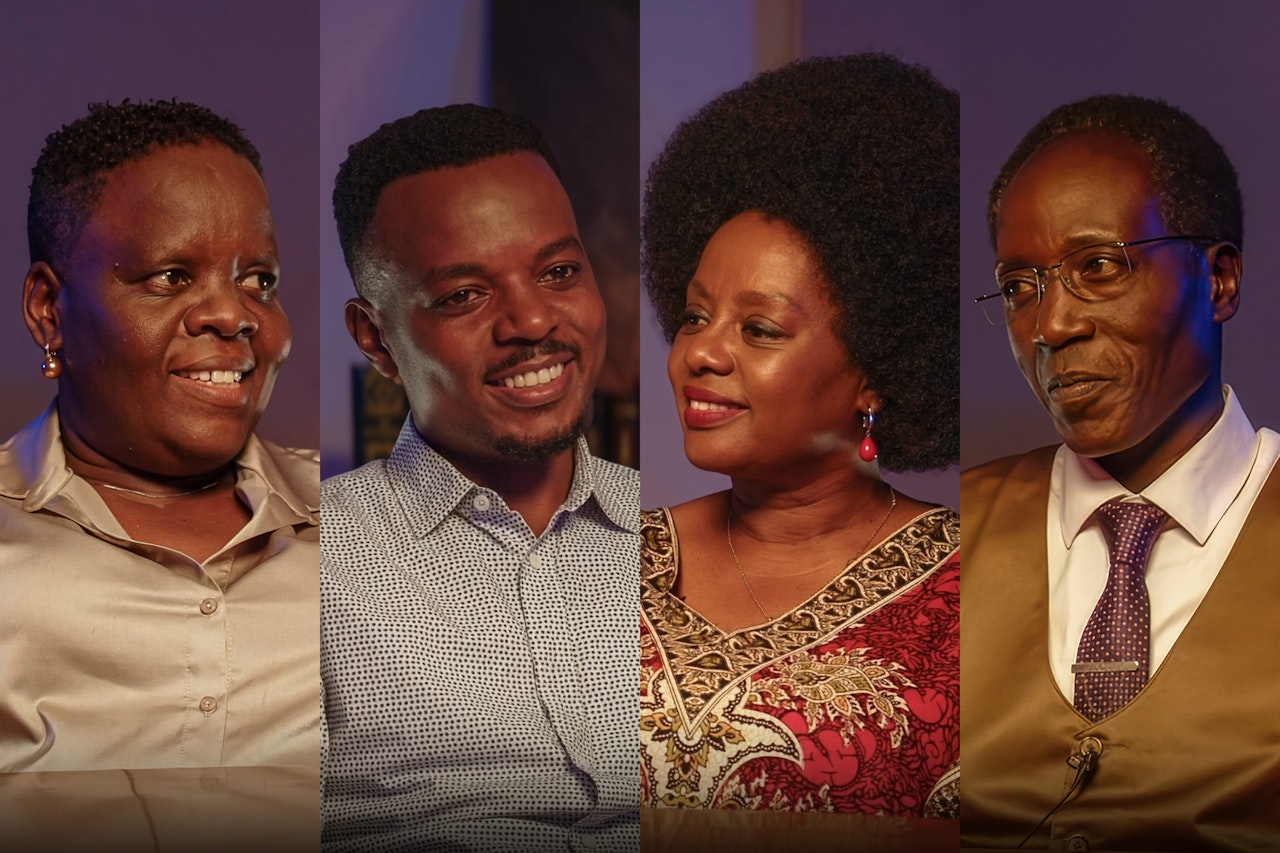
This podcast episode explores how in Kenya, participation in Bahá’í moral and spiritual education is raising consciousness about individual and collective responsibility.
February 5, 2026
BAHÁ’Í WORLD CENTRE — In the latest podcast episode of “In Conversation,” guests from Kenya describe how communities across the country are reflecting on their role in shaping a better future.
Within communities, through participation in the moral and spiritual education programs offered by the Bahá’í training institute, people are coming together to explore how personal transformation is intimately connected to the well-being of society.
Thomas Ouma K’Ong’any, a member of a Bahá’í agency at the national level in Kenya, shares an account from central Kenya where the transformative effect of the training institute is becoming evident. “A group of youth who even their parents and the community somehow had lost hope about,” were invited to participate in a training program, describes Mr. K’Ong’any. “At the end of this training, these youth were so changed that when they went back to their communities, even their parents could not imagine” what had transformed these youth, he added.
These moral and spiritual education programs are also raising consciousness and capacity among groups of women. Lucy Imison, a member of the Bahá’í National Spiritual Assembly of Kenya, describes how through these programs women in two regions began to identify their needs and aspirations, forming meaningful bonds of friendship.
These women asked themselves: How can we increase our income to afford education for our children? How can we evolve as individuals and collectively as a group? What emerged was a farming initiative in which mothers came together to produce and sell their own food while learning constructive farming practices. “When the women do this, they don't do it alone,” Mrs. Imison adds. “We also see they are getting support from their husbands.”
Frank Mureithi, another member of a Bahá’í agency at the national level in Kenya, notes that contemporary discourse often associates social transformation with governance, policy, and technological advancements. However, Mr. Mureithi suggests that social transformation must also “happen at the level of the individual.” Through interaction with community-building activities, people are beginning to see themselves as protagonists in the development of their community.
When such transformation occurs at the level of the heart, he said, “a reorientation in terms of how we think about the structures of society and the purposes they are supposed to fulfill” emerges. “We start seeing new patterns of thought, new patterns of behavior, new patterns of habit” at the level of the individual, community, and institutions.
Linet Nafula Kisaka, a member of the Board of Counsellors in Africa, shares an account from a village in Nairobi where individuals in leadership roles came together to think about “how they can exercise their authority” in connection with the Bahá’í teachings. While this community had many local councils addressing various needs, through these consultative efforts “there emerged a systematic community gathering that is now happening every cycle.”
“In this community gathering, each member of this council shares what has happened in the past three months. After that, they think about what they will do in the course of the three months before they come for another gathering,” she says.
Mr. K’Ong’any explains how the House of Worship in Matunda Soy, which “embodies two aspects: service and worship,” is influencing the processes of transformation throughout neighboring communities. As people interact with the House of Worship, he explains, “when they go back, they are inspired and they are able to undertake a more active role” in contributing to the well-being of their communities.
Mrs. Kisaka adds that the House of Worship is “strengthening this principle of the oneness of humanity—the appreciation of the population that regardless of their religious backgrounds, they are welcome at the house of worship to pray.”
The podcast episode is part of the “In Conversation” series, a collective exploration by several individuals of the practical application of Bahá’í principles to the building of peaceful societies.