Bahá’í World News Service
Baha’i International Community
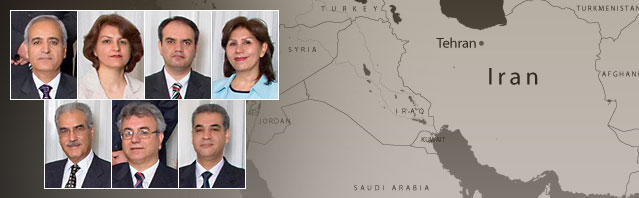
The seven Iranian Baha’i leaders who formerly looked after the needs of Iran’s Baha’i community.
Trial of Iran’s seven Baha’i leaders
United Nations statements
In recent years the United Nations – through its General Assembly and in reports by its Secretary General and a number of Special Rapporteurs – has called upon the Islamic Republic of Iran to account for its actions.
The Baha’i International Community has also made a number of statements to the UN Human Rights Council in Geneva, transcripts of which can be linked to below.
Statements of the United Nations
Report of the Secretary-General on the situation of human rights in the Islamic Republic of Iran
The Secretary General noted “that Iran has a policy of systematic persecution and excommunication of persons belonging to the Baha’i faith from the application of freedom of religion or belief by simply denying their faith to have the status of a religion. Authorities in Iran regard Baha’ism as a political or cult organisation and stress that members of the organisation have never obtained the required permit, which makes their activities illegal and against the existing regulations.”
Download full report PDFReport of the Special Rapporteur on the situation of human rights in the Islamic Republic of Iran
“The Special Rapporteur continues to be alarmed by communications that demonstrate the systemic and systematic persecution of members of unrecognized religious communities, particularly the Baha’i community, in violation of international conventions. Moreover, the Government’s tolerance of an intensive defamation campaign meant to incite discrimination and hate against Baha’is violates its obligations as set out in article 5 of the International Convention on the Elimination of All Forms of Racial Discrimination. According to one report, 440 instances of slanderous speech against Baha’is were published or broadcasted in the past two years…”
Download full report PDFThe situation of human rights in the Islamic Republic of Iran
The General Assembly expresses “deep concern at serious ongoing and recurring human rights violations in the Islamic Republic of Iran relating to, inter alia: Increased persecution and human rights violations against persons belonging to unrecognized religious minorities, particularly members of the Baha’i faith, including escalating attacks on Baha’is and their defenders, including in Statesponsored media, a significant increase in the number of Baha’is arrested and detained, including the targeted attack on the Baha’i educational institution, the reinstatement of twenty-year sentences against seven Baha’i leaders following deeply flawed legal proceedings, and renewed measures to deny Baha’is employment in the public and private sectors;
Download full report PDFReport of the Secretary-General on the situation of human rights in the Islamic Republic of Iran
“Restrictions on the overall enjoyment of human rights by unrecognized religious minorities, particularly the Baha’i community, remain of serious concern. According to numerous reports, on 21 May 2011, security forces conducted raids on the homes of individuals involved in the activities of the Baha’i Institute for Higher Education and arrested 15 of its members in various cities, including Gohardasht, Isfahan, Karaj, Sari, Shiraz, Tehran and Zahedan…The Institute has been subject to consistent raids since its establishment in 1980. On 4 June 2011, a State news agency quoted a statement from the Ministry of Science and Technology, declaring the activities of the Institute to be illegal and all diplomas and degrees issued by that institution to be lacking legal validity. In August 2010, seven other Baha’i community leaders, who had been detained in May 2008 and produced for a trial in January 2010, were sentenced to 20 years in prison, which was subsequently reduced to 10 years. In March 2011, the court, however, reportedly reinstated the original prison sentence of 20 years. The High Commissioner for Human Rights has raised this case several times in letters to and meetings with the Iranian authorities, expressing deep concern that these trials did not meet the requirements of due process and fair trial. The authorities report that the seven were convicted on a combination of private complaints and national security charges and not in relation to their beliefs.”
Download full report PDFInterim report of the Secretary-General on the situation of human rights in Iran
“Concerns continued with respect to the treatment of the Baha’i community and other minorities in Iran which have been highlighted in previous reports of the Secretary-General to the General Assembly. Special Procedures mandate holders continued to raise cases involving members of the Baha’i community with the Iranian authorities. The authorities note that while Baha’i is not recognized as an official religion, its followers enjoy equal social, civil and citizen’s rights; they assert, however, that the Baha’i community has recruited members by irregular means or has acted against national security…”
Download full report PDFReport of the Special Rapporteur on freedom of religion or belief, Heiner Bielefeldt
The Special Rapporteur expressed that he was “very concerned by the arrest and detention of members of the Baha’i community and the continued violations of their freedom of religion or belief…With regard to the judgement of 7 August 2010 against Ms. Fariba Kamalabadi, Mr Jamaloddin Khanjani, Mr. Afif Naeimi, Mr. Saeid Rezaie, Mr. Behrouz Tavakkoli, Mr.Vahid Tizfahm and Ms. Mahvash Sabet, he would like to remind that their case has been the subject of previous communications sent jointly by several Special Procedures mandateholders… Furthermore, the Working Group on Arbitrary Detention issued Opinion No. 34/2008 stating that the detention of the individuals in this case was arbitrary and contrary to articles 9, 10 and 18 of the Universal Declaration of Human Rights and 9, 14 and 18 of the International Covenant and Civil and Political Rights, to which the Islamic Republic of Iran is a State party. The Working Group on Arbitrary Detention also held that this case fell within category II of the categories applicable to the consideration of the cases submitted to the Working Group and called for the immediate and unconditional release of the above-mentioned persons…”
Download full report PDFThe situation of human rights in the Islamic Republic of Iran
The United Nations General Assembly expresses its “deep concern at serious ongoing and recurring human rights violations in the Islamic Republic of Iran” including, “Continued discrimination and other human rights violations, at times amounting to persecution, against persons belonging to ethnic, linguistic, recognized religious or other minorities, including, inter alia, Arabs, Azeris, Baluchis, Kurds, Christians, Jews, Sufis and Sunni Muslims and their defenders; Increased incidents of persecution against unrecognized religious minorities, particularly members of the Baha’i faith, including attacks on Baha’is, including in State-sponsored media, increasing evidence of efforts by the State to identify, monitor and arbitrarily detain Baha’is, preventing members of the Baha’I faith from attending university and from sustaining themselves economically, the confiscation and destruction of their property, the vandalizing of their cemeteries and the sentencing of seven Baha’i leaders to ten years imprisonment despite being repeatedly denied the due process of law that they are constitutionally guaranteed, including the right to timely and adequate access to legal representation of their choice and to a fair and open trial…”
Download full report PDFReport of the Secretary General on the situation of human rights in the Islamic Republic of Iran
“Members of unrecognized religions, in particular the Baha’i, who comprise the country’s largest non-Muslim religious minority, face multiple forms of discrimination and harassment, including denial of employment, Government benefits and access to higher education. Some members of the Baha’i community have faced arbitrary detention or the confiscation and destruction of their property. In February 2009, the Special Rapporteur on freedom of religion or belief and the Independent Expert on minority issues noted with concern the deliberate damage to properties belonging to members of the Baha’i community. Fires had been deliberately set to partially or totally destroy homes and vehicles, and a cemetery in Marvdasht had been vandalized. The incident was allegedly reported to a number of Government agencies, but no official action has been taken. The authorities state that while Baha’i is not recognized as an official religion, its followers enjoy equal social, civil and citizens’ rights. The United Nations High Commissioner for Human Rights wrote to the authorities on several occasions to express concern and seek clarification about the status of the seven members of the Baha’i community who had been detained since 14 May 2008 and whose trial began on 12 January 2010 for charges including “acting against national security, espionage and spreading corruption on earth”, which could entail the death penalty. The authorities also state they were responding to complaints from private individuals that they had been threatened or intimidated by an entity affiliated with the Baha’is. The High Commissioner requested the authorities to allow independent monitoring of such high-profile trials, but this request was not granted. On 14 June 2010, the trial was concluded after three days of consecutive court appearances. At the time of writing the present report, there were unconfirmed reports that these seven members of the Baha’i community would receive prison sentences of 20 years. The High Commissioner, through a number of letters, expressed deep concern that in the absence of any independent observers, these trials did not meet due process and fair trial requirements. The High Commissioner voiced grave concern that the criminal charges brought against the above-mentioned individuals appeared to constitute a violation of the Islamic Republic of Iran’s obligations under the International Covenant on Civil and Political Rights, in particular those of freedom of religion and belief and freedom of expression and association.”
Download full report PDFThe situation of human rights in the Islamic Republic of Iran
The United Nations General Assembly “expresses its deep concern at serious ongoing and recurring human rights violations in the Islamic Republic of Iran relating to: “Increasing discrimination and other human rights violations against persons belonging to religious, ethnic, linguistic or other minorities, recognized or otherwise, including, inter alia, Arabs, Azeris, Baluchis, Kurds, Christians, Jews, Sufis and Sunni Muslims and their defenders, and, in particular, attacks on Baha’is and their faith in State-sponsored media, increasing evidence of efforts by the State to identify, monitor and arbitrarily detain Baha’is, preventing members of the Baha’I faith from attending university and from sustaining themselves economically, and the continuing detention of seven Baha’i leaders who were arrested in March and May 2008 and faced with serious charges without adequate or timely access to legal representation; …”
Download full report PDFReport of the Secretary-General on the situation of human rights in the Islamic Republic of Iran
“The United Nations High Commissioner for Human Rights wrote on numerous occasions to express concern and seek clarification about the status of seven members of the Baha’i faith who had been detained for more than a year. On 14 May 2008, six members of the Baha’i community — Fariba Kamalabadi, Jamaloddin Khanjani, Afif Naeimi, Saeid Rezaie, Behrouz Tavakkoli, Vahid Tizfahm — reportedly were arrested and have since been held in Evin prison. On 5 March 2008, a seventh member of the Baha’i community, Mahvash Sabet, was reportedly detained by the Iranian authorities and has since been allegedly held incommunicado in Mashhad. The Iranian authorities replied to the concerns of the High Commissioner on 20 February 2009, noting that the arrest of the seven Baha’is was as a result of their illegal activities. Subsequently, OHCHR expressed concern about reports that additional charges had been laid against the seven, including spreading corruption on earth (mofsed fil arz), which carries the death penalty. The Iranian Government reported that the charges included threatening and intimidating Iranian citizens to join the “sect organization”, meddling with the private lives and beliefs of Iranian citizens and forming a clandestine organization. The seven have yet to be produced before a court and have been denied access to their lawyer. The High Commissioner and the Secretary-General remain concerned that the detention of those individuals may breach the obligations of the Islamic Republic of Iran under the International Covenant on Civil and Political Rights, in particular freedom of religion and belief and freedom of expression and association.”
Download full report PDFThe situation of human rights in the Islamic Republic of Iran
The resolution, which passed by a vote of 69 to 54, specifically criticized Iran’s use of torture, the high incidence of executions, the “violent repression” of women, and “increasing discrimination” against Baha’is, Christians, Jews, Sufis, Sunni Muslims, and other minorities… “and, in particular, attacks on Baha’is and their faith in State-sponsored media, increasing evidence of efforts by the State to identify and monitor Baha’is, preventing members of the Baha’i faith from attending university and from sustaining themselves economically, and the arrest and detention of seven Baha’i leaders without charge or access to legal representation;”
Download full report PDFReport of the Secretary-General on the situation of human rights in the Islamic Republic of Iran
“On 18 May 2008, it was reported that six members of the Baha’i leadership in the country had been arrested and a seventh member had been detained incommunicado in Mashhad since 5 March 2008. Subsequently, on 23 May, the High Commissioner wrote to the Iranian authorities asking for information on the reports in the light of the obligations of the Islamic Republic of Iran under the International Covenant on Civil and Political Rights to ensure that no one is detained arbitrarily and to uphold the right to freedom of religion or belief. The Iranian authorities insist that the arrests were made on national security grounds.”
Download full report PDFStatements of the Baha’i International Community
Interactive dialogue with the Special Rapporteur on the right to education
“Mr. Rapporteur, our question is this: Has denial of higher education and persecution of Bahá’í children in school been raised in your communications with the Islamic Republic of Iran? And if so, what has been their answer to this clear violation of human rights?
Download full report PDFOral statement to HRC 20th Session
“The government is so determined to suffocate the Baha'i community economically that officials do not bat an eye when these measures also cause hardship for the majority Shi’i Muslim population. Licenses are revoked for Muslim business partners of Baha'is, as well, and in Semnan, one of the factories closed in May had 51 employees: 15 Baha'is and 36 non-Baha'is.”
Download full report PDFContribution to the report of the Secretary-General to the General Assembly on “Combating intolerance, negative stereotyping, stigmatization, discrimination, incitement to violence and violence against persons, based on religion or belief”
“Attacks on the Baha'i Faith and its adherents regularly appear in Iranian State-controlled and State-sanctioned media (press, radio, TV, websites, etc.), as well as in pamphlets and tracts distributed in officially approved public exhibitions and events, and in government-sponsored seminars, conferences, workshops and symposia. The vilification disseminated by these sources has been used by Iranian teachers, school management, other public officials, groups and individuals in thousands of incidents involving verbal (and sometimes also physical) abuse directed against Baha'i school children and students, military trainees, shop keepers and other identified members of the community. Moreover, stigmatization and incitement to hatred promulgated by officials and members of the clergy underlie the on-going oppression against Baha'i citizens of Iran, creating a climate where human rights violations against them are condoned, tolerated or ignored.”
Download full report PDFUN Human Rights Council – 19th session
“Now the government is trying to identify their children, in kindergarten. Surely we must all ask: what for? The government is well aware that Baha'is are not a threat, that schoolchildren are not a threat. So the question is: In the face of the Iranian government’s policy to eliminate the Baha'i community as a viable entity in that country, what is the international community going to do to protect the Baha'is of Iran?”
Download full report PDFQuestion in Interactive dialogue with the Special Rapporteur on the situation of human rights in the Islamic Republic of Iran
Questions posed to the Special Rapporteur by the Baha’i International Community were: “Given Iran’s refusal to engage in any substantive manner with UN human rights mechanisms, how should the international community respond? What can it do when a government like Iran refuses to recognize a community’s right to exist? How can the international community protect people who belong to the most vulnerable minorities?”
Download full report PDFOral statement to the 18th session of the UN Human Rights Council
“The recent crackdown on the Baha'i Institute of Higher Education, a grassroots endeavour that stemmed from this injustice and was trying to alleviate the failure of the State to act fairly towards its citizens, is proof – if yet another proof is needed – that, despite all their claims (whether at the Human Rights Council, at UNESCO or on State television), the Iranian government aims at turning the entire Baha’i community of its country into an impoverished and marginalized group.”
Download full report PDFOral statement to the 17th session of the UN Human Rights Council
“…Baha'i volunteers offered university-level courses for other Baha'is in the privacy of their own homes – a quiet, peaceful initiative called the Baha'i Institute for Higher Education. Over the past 20 years, the government has tried three times to stop this effort. Three weeks ago, intelligence agents raided 40 Baha'i homes and arrested 18 of the volunteers in a concerted effort to crush their initiative – proving beyond any doubt that the government is determined to deny higher education (in any form, from any source) to all known Baha'is in Iran. The government flouts the international covenants to which it is a signatory and violates the laws of its own land and then shamelessly tries to garner support for its stance and to hide the true motive behind its actions under a peremptory statement that the Baha'i Institute for Higher Education is “illegal”. Where is the logic here? How can Iran possibly deny that it persecutes the Baha'is? If ever there were a case of actions speaking louder than words, this surely is it.”
Download full report PDFOral statement to the 16th session of the UN Human Rights Council Special Rapporteur on freedom of religion or belief
“In some countries, children face this kind of discrimination because they belong to religious minorities, because their faith is rejected and ostracized.”
Download full report PDFOral statement to the 15th session of the UN Human Rights Council
“These people never acted against the State. They chose to stay in Iran despite all the hardships because their beliefs inspired them to serve their country and their fellow citizens. They are innocent of all the charges laid against them. The case against them is utterly without foundation. They have been subjected to a gross and flagrant miscarriage of justice, and we call for their immediate and unconditional release.”
Download full report PDFOral statement to the 14th session of the UN Human Rights Council
“The Baha'i International Community is deeply disturbed by the Iranian government’s refusal to accept basic recommendations concerned with ending injustice, persecution and discrimination in that country. We wish to see the current tragic chapter of Iran’s history closed, and believe meaningful engagement in the UPR process to be imperative in that regard.”
Download full report PDFOral statement to the Fourteenth Session of the UN Human Rights Council, Geneva
"Baha’i children are intimidated and harassed by teachers and school officials, and Baha’i students denied access to university. The government applies many restrictions on employment, including a list of 25 trades from which Baha’is are banned, and denies their right to pensions and inheritance. Unfortunately, these violations are ongoing and well-known. Less well-known is the fact that Baha’is are incarcerated for years in pre-trial detention facilities, under very harsh conditions."
Download PDFOral statement to the 13th session of the UN Human Rights Council, on freedom of religion or belief
“For the record, we would like to state that independent investigation of truth is one of the central principles of the Baha'i Faith. For Baha'is, beliefs are an internal and personal matter; no person or institution has the right to exert compulsion in matters of belief. Acceptance of the Faith is the voluntary act of an individual, and any Baha'i is free to leave the Faith. In the Baha'i Faith there is no such thing as apostasy.”
Download full report PDFOral statement to the Thirteenth Session of the UN Human Rights Council, Geneva
"These people have never acted against the security of the State. On the contrary, they decided to stay in Iran despite all the hardships suffered solely because of their beliefs, to serve their country and their fellow citizens. One of their lawyers, Nobel Laureate Shirin Ebadi, has stated that their case files do not contain a single piece of incriminating evidence. They are innocent and should be released. Their case has become a symbol of the persecution against all members of this religion in Iran."
Download PDFOral Statement to the Twelfth Session of the UN Human Rights Council, Geneva
"However, today, we are compelled to bring to the attention of the Council a new and even more callous stratagem, in which the city of Semnan is the site of a covert experiment to eliminate the Baha’i community across Iran. The methodology involves systematic implementation of the various measures outlined in the government’s 1991 secret memorandum, together with intensive efforts to incite the Iranian people to hate and distrust the Baha’is. "
Download PDFOral Statement to the Eleventh Session of the UN Human Rights Council
"The charge of “spreading corruption” was misused against many Baha’is who were executed in the years immediately following the Islamic Revolution. Its utilization again in this case demonstrates that the authorities have no basis for any allegation against these individuals, other than blatant religious persecution. Clearly, this action reflects the government’s sharply increased persecution of the entire Baha’i community, the largest religious minority in Iran."
Download PDFQuestion for interactive dialogue with Ms. Asma Jahangir, Special Rapporteur on freedom of religion or belief, Tenth Session of the UN Human Rights Council, Geneva
"Have you received any information recently from the Iranian government about this case? And what do you think the next steps could be, to protect the (over 300,000) Baha’is in Iran?"
Download PDFOral Statement of the Baha’i International Community to the Tenth Session of the UN Human Rights Council, Geneva
"Is it a threat for a nation if Baha’is discuss high-minded ideals with their neighbors? Is it a threat to society if Baha’is speak about the true nature of their Faith, in the privacy of their homes, with friends who have wondered about the negative portrayal of Baha’is in the Iranian media? What harm is done if families gather for communal worship and discussion? Is it unreasonable for a group of Baha’is – in the absence of their administrative institutions, denied them by the government – to facilitate the marriage of couples, the education of children and the burial of the dead in accordance with the tenets of their Faith? It is because the Baha’is manifest their Faith, in word and deed, that they are persecuted in Iran."
Download PDFOral Statement of the Baha’i International Community to the Eighth Session of the UN Human Rights Council, Geneva
"The mere fact that the government tells Baha’is they can be released, if they agree to recant their faith, clearly demonstrates that the real issue is their religious beliefs, which they freely share with their fellow citizens – a right laid down in Article 18 of the International Covenant on Civil and Political Rights, to which the government of Iran is signatory. While denying that religion is the issue, the authorities provide a platform, in mosques, in government sponsored media and even in schools across the country, for incitement to hatred and defamation of the Baha’i Faith. And when violent acts are committed – such as attempting to set a man on fire, demolishing people’s homes, or exhuming remains and crushing the bones under the wheels of a car – the perpetrators enjoy total impunity."
Download PDFOral statement to the seventh session of the UN Human Rights Council
“Moreover, the totally irrational nature of this persecution – and the fact that it is solely based on intolerance of a differing religious belief – is evident when one analyzes last year’s sentencing of the 53 Baha'is in Shiraz. They were doing volunteer work, together with some Muslims, in service projects to help children of underprivileged families. Greatly appreciated by the Muslim parents, the projects assisted hundreds of children for several years. But then the Baha'is were identified and arrested, and the projects were shut down. Muslims working alongside the Baha'is were also detained but freed the same day.”
Download full report PDFOral Statement to the Fourth Session of the Human Rights Council
“Right now, however, we feel it is essential for the international community to express its concern at the coordinated nature of the attempt to identify all members of the community in Iran, combined with the upsurge, during the same period, of articles, broadcasts and websites condemning the Baha'is and their beliefs.”
“We cannot forget that twice before, in the 1950s and again in the 1980s, media campaigns of this nature led to violence against the Baha'i minority and the deaths of Baha'i men, women and children.”
Download full report PDFTreatment of the Followers of the Baha'i Faith in the Islamic Republic of Iran
“Exacerbating these alarming trends, Baha'is across Iran are now experiencing an escalation in acts of personal harassment and violence. In the last two years, over 60 Baha'is have been jailed or imprisoned without charge; personal property and holy sites of deep significance to the Baha'i Faith have been destroyed, a gravesite was razed with tombstones smashed and coffins left exposed. Most recently, a movement appears to have targeted Baha'i households, which have begun receiving notes, CDs, and tracts, all of which are aimed at refuting the claims of the Baha'i Faith.”
Download full report PDFOral Statement to the 61st Session of the Commission on Human Rights
“Indeed, human rights violations in Iran have again become so grave that, in our view, they warrant a clear signal from the international community and a decision to re-establish international monitoring – now”
Download full report PDFWritten statement to the 55th Session of the UN Commission on Human Rights under Agenda item 10 of the provisional agenda: The Right to Education.
“The exclusion of Baha'is from access to higher education in Iran certainly constitutes a gross violation of the Covenant. These latest steps taken to shut down the Iranian Baha'i community's creative and peaceful response only increases public outrage regarding the Iranian government's attempt to strangulate the Baha'i community.”
Download full report PDF- News Service Home >
- Human Rights in Iran >
- Special Report